
The 192.168.1.2 IP address is a private IPv4 address that can be used by a router, wireless access point, computer, printer, or another device on a local network. If this address belongs to your router or network device, you may be able to enter it in a web browser to open the administration page.
The login process is simple when you have the correct address and login details. However, not every router uses 192.168.1.2 as its default login address. Some routers use 192.168.1.1 or 192.168.0.1 instead.
This guide explains how to access 192.168.1.2, check the correct username and password, change your Wi-Fi settings, and fix common connection problems. You will also learn how to identify the correct router IP address if the login page does not open.
What Is the 192.168.1.2 IP Address?
192.168.1.2 is a private IPv4 address used within local networks. A home router may assign this address to a connected device, or a network administrator may set it manually for a router, access point, or other network equipment.
An IP address helps devices send information to the correct destination. On a home network, your router uses local IP addresses to communicate with phones, laptops, smart TVs, printers, and other connected devices.
The address 192.168.1.2 belongs to the private address range from 192.168.0.0 to 192.168.255.255. This range is reserved for private networks and is not meant to be routed directly across the public Internet.IANA explains the private IPv4 address ranges.
🌐 Need help accessing your router settings at 192.168.3.1? Check our 192.168.3.1 Login Information for useful details.
Is 192.168.1.2 a Private or Public IP Address?
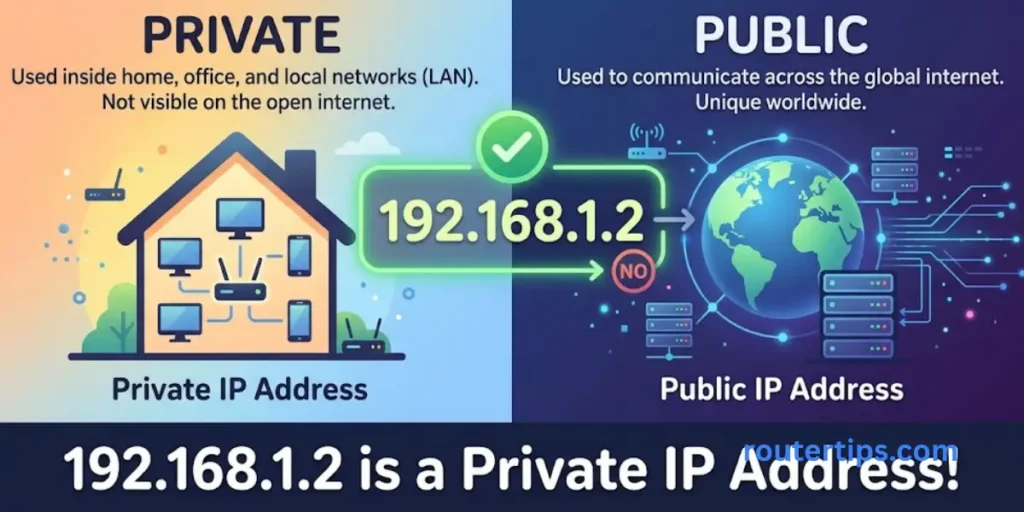
192.168.1.2 is a private IP address. It can be used inside a home, office, school, or other local network without requiring a unique public IP address.
For example, your home router might use 192.168.1.1 as its local address and assign 192.168.1.2 to a laptop. Another device might receive 192.168.1.3.
These addresses help the router manage communication between devices on the same network.
A private IP address does not identify a person’s exact location on the public Internet. The same address can be used by many unrelated networks around the world.
Your public IP address is different. It is the address associated with your Internet connection as seen by external websites, although shared connections and network address translation can affect how that address is assigned and used.
🌐 Want to understand the 192.168.1.100 IP address and how it works on your network? Read our 192.168.1.100 IP Address Overview for helpful details.
What Is 192.168.1.2 Used For?
The purpose of 192.168.1.2 depends on how your local network is configured.
Common uses include:
- Router administration: It may open a router’s settings page if the router uses this address.
- Wireless access points: An access point may use it for local management.
- Connected devices: A computer, printer, camera, or smart device may receive this address from the router.
- Manual IP assignment: A network administrator may assign it to a device that needs a consistent local address.
- Network troubleshooting: You can use the address to check whether a device is reachable on your local network.
Do not assume that 192.168.1.2 is always your router’s login address. First, check which device has been assigned that IP address.
🌐 Need help understanding the 10.0.0.2 IP address or accessing a network device? Read our 10.0.0.2 IP Address Details for helpful information.
Is 192.168.1.2 the Same as 192.168.1.1?
No. These are two separate IP addresses, although both belong to the same private IPv4 address range.
| IP address | Possible use |
| 192.168.1.1 | Router or default gateway |
| 192.168.1.2 | Connected device, access point, or configured router address |
| 192.168.1.3 | Another device on the local network |
| 192.168.0.1 | Common router address on a different local subnet |
| 192.168.1.254 | Another possible router or gateway address |
These are examples, not fixed assignments. Your network may use a different address plan.
If you enter 192.168.1.2 and see a login page, check the page title and device information before making changes. If the page does not open, find your actual default gateway.
How to Log In to 192.168.1.2
You can try accessing the 192.168.1.2 login page from a computer or phone connected to the relevant local network. You will need the correct device credentials to change its settings.
Follow these steps.
Connect to the Correct Network
Connect your computer or phone to the router’s Wi-Fi network. You can also use an Ethernet cable if the device has a suitable port.
If you are connected to a guest network, a separate access point, or a different router, the administration page may not be available.
Make sure your device is connected to the network that contains the device assigned to 192.168.1.2.
Open a Web Browser
Open a browser such as Chrome, Firefox, Edge, or Safari.
Type the following address into the browser’s address bar:
http://192.168.1.2
Press Enter or Go.
Enter the address in the address bar, not the search box. Otherwise, your browser may treat it as a search query.
If the device requires HTTPS, try https://192.168.1.2 only if the device documentation or configuration supports it. A browser security warning may appear if the device uses a certificate that your browser does not trust. Do not ignore security warnings without checking that you are connecting to the correct device.
Enter the Router Username and Password
If the login page opens, enter the administrator username and password for that device.
The credentials may be printed on the device label, included in the setup instructions, or created during the initial setup.
Some devices require an administrator password without a separate username. Others use a local account that was created by the owner or network administrator.
There is no universal username and password for 192.168.1.2 because the IP address does not determine the device’s login settings.
Open the Administration Settings
After signing in, look for the relevant menu. Depending on the device, it may be called:
- Wireless or Wi-Fi Settings
- Network Settings
- LAN Settings
- Administration
- Security
- System Tools
Menu names vary by manufacturer and model.
Before changing anything, note the current settings if you may need them later. Avoid changing advanced network settings unless you understand their purpose.
Save Your Changes
If you update a password, network name, or other setting, save the changes before leaving the page.
Some devices restart their wireless service after a change. You may need to reconnect your phone, laptop, or other devices using the updated Wi-Fi details.
If you cannot reach the login page, continue to the troubleshooting section below.
Default Username and Password for 192.168.1.2
There is no single default username or password for the 192.168.1.2 login page. The correct credentials depend on the device, its manufacturer, the Internet service provider, and whether someone has changed the original settings.
A router using this IP address may have different login details from another router using the same address.
Where Can You Find the Default Router Password?
If you own the device or have permission to manage it, check these sources first:
- Device label: Look at the back or bottom of the router or access point. Some devices list a default username, password, or setup address.
- User manual: The manufacturer’s manual may explain how to sign in and complete the first setup.
- Official support website: Search for your exact model number on the manufacturer’s website.
- ISP instructions: If your provider supplied the router, check its setup instructions or contact its support team.
- Saved credentials: If you previously changed the password, check your password manager or other secure records.
Some newer devices ask you to create an administrator password during setup. In that case, there may not be a usable factory password printed on the device.
What If the Default Password Does Not Work?
First, check that you are using the correct device’s login page. You may be trying to sign in to an access point, extender, or another device instead of your main router.
Next, confirm the exact model and check its official login instructions. If the administrator password was changed, the original factory credentials may no longer work.
Do not keep guessing passwords or rely on random credential lists. If you cannot recover access, use the manufacturer’s supported recovery method. A factory reset may be an option, but it should not be your first step because it can erase important settings.
How to Change Your Wi-Fi Password at 192.168.1.2
If 192.168.1.2 is the administration address of your router or access point, you may be able to change the Wi-Fi password through its settings page.
Before starting, understand the difference between two passwords:
- Wi-Fi password: Used by phones, computers, and other devices to join the wireless network.
- Administrator password: Used to access the device’s management settings.
Changing one does not always change the other.
Sign In to the Device
Open http://192.168.1.2 in your browser while connected to the correct network.
Enter the administrator credentials. If the page does not open, confirm the device’s actual IP address before continuing.
Open Wireless Settings
Look for a menu called Wireless, Wi-Fi, WLAN, or Wireless Security.
The exact name depends on your device. Some routers have separate settings for the 2.4 GHz and 5 GHz bands. Newer models may also provide a 6 GHz network.
If the router uses separate network names, check which network you want to update.
Enter a New Wi-Fi Password
Find the field labeled Wi-Fi Password, Wireless Password, Security Key, or a similar name.
Create a strong password that is difficult to guess. Avoid using your name, phone number, home address, or a simple sequence of numbers.
A long, unique password is generally a better choice than a short, predictable one. Do not reuse a password that you use for email or other important accounts.
Check the Security Setting
If your router supports WPA3, consider using it. WPA2 with AES is a suitable alternative for many devices that do not support WPA3.
Avoid outdated security options when a stronger supported choice is available. If an older device cannot connect, check the manufacturer’s instructions before weakening the network’s security.
Save the New Settings
Click Save, Apply, or the equivalent option.
Your Wi-Fi connection may disconnect. Reconnect each phone, laptop, television, and other wireless device using the new password.
If the router uses the same network name for multiple bands, one change may affect all of them. Check the device’s instructions to understand how its settings work.
How to Change the Router Administrator Password
Changing the administrator password helps protect your router settings from people who should not have access.
The steps are similar to changing a Wi-Fi password, but the setting is usually found under Administration, System, Security, or Management.
- Open the correct router administration page.
- Sign in using the current administrator credentials.
- Find the administrator account or password setting.
- Enter the current password if the device requests it.
- Create and save a new, strong password.
- Store the new credentials in a secure password manager.
If the device supports separate administrator accounts, use an account with only the access needed for each person.
Keep the administrator password different from the Wi-Fi password. This reduces the risk that someone who knows the wireless password can also access the management settings.
If you are managing a work or shared network, check with the network administrator before making changes.
Which Router Brands Use 192.168.1.2?
The address 192.168.1.2 is not exclusive to one router brand. It can be assigned to many types of network equipment when the network configuration allows it.
The most reliable way to identify the device is to check its model number and the connected-device list on the main router.
192.168.1.2 on TP-Link Devices
TP-Link makes routers, mesh systems, range extenders, and other networking products. Their default addresses vary by product.
For example, TP-Link states that many of its standard routers use 192.168.0.1 or 192.168.1.1. Its Deco mesh systems commonly use 192.168.68.1 as the default local address. These details are listed in itsofficial router IP address instructions.
This means you should not assume that 192.168.1.2 is the default address for every TP-Link router.
If a TP-Link device has been assigned 192.168.1.2, check its model-specific documentation and the network’s current configuration before signing in.
192.168.1.2 on Wireless Access Points
An access point extends or provides wireless network access. Depending on the network setup, it may have its own local management address.
An access point can receive an address automatically from the main router or use an address configured by an administrator. In some setups, that address could be 192.168.1.2.
If you cannot access the device, open the main router’s connected-device or DHCP client list. Look for the access point’s name or hardware address, also called a MAC address.
The list may help you match the device to its current local IP address.
How to Check Your Router’s Actual Login Address
Your router’s local address is often listed as the default gateway on the device connected to the network.
On Windows, open Command Prompt and enter:
ipconfig
Find the active network adapter and look for Default Gateway.
On a Mac, open System Settings, select Network or Wi-Fi, and check the connection details. The router address is usually listed under TCP/IP.
On a phone, open the settings for the connected Wi-Fi network. Look for a field labeled Router or Gateway. The name and location of this field vary by operating system and version.
For a TP-Link device, you can also consult its official instructions for finding the LAN IP address on different operating systems.
Why Is 192.168.1.2 Not Working?
If the 192.168.1.2 login page does not open, the address may not belong to your router. A network connection problem, incorrect address, browser issue, or access restriction may also be responsible.
Try these checks in order.
Check the IP Address
Make sure you typed 192.168.1.2 correctly.
A common mistake is using the letter “l” instead of the number “1.” The address must contain numbers separated by periods.
Also, check whether the device actually uses this address. Your router may have a different default gateway.
Connect to the Correct Network
Connect directly to the relevant Wi-Fi network or use Ethernet if available.
If you are connected to a guest network, mobile data, a VPN, or another network, access to the local administration page may be blocked or unavailable.
For testing, turn off mobile data temporarily if your phone keeps using it instead of Wi-Fi. If a VPN changes your local network access, disconnect it briefly and try again, provided doing so is allowed by your network rules.
Find the Default Gateway
The default gateway is the local address your device normally uses to reach other networks.
On Windows, run ipconfig and check the active adapter’s Default Gateway field. On macOS or a phone, look in the active network’s details for Router or Gateway.
If the gateway is 192.168.1.1, that may be the address you need to open the main router’s settings. It does not mean 192.168.1.2 is invalid. It may simply belong to another device.
Check the Router and Network Connection
Make sure the router or access point is powered on. Check the cables, indicator lights, and Wi-Fi connection.
If you use Ethernet, confirm that the cable is securely connected and that the correct network adapter is active.
You can also try another browser or device. This helps determine whether the issue is limited to one device or affects the entire network.
Check for an IP Address Conflict
Two devices should not normally use the same IP address on the same local subnet at the same time. If they do, network communication may become unreliable.
A router’s connected-device list can help you check which device has been assigned 192.168.1.2. If you suspect a conflict, review the DHCP and manual IP settings before changing them.
Avoid assigning a random static IP address without checking the network’s address range and existing assignments.
Check the Device’s Access Settings
Some routers allow local management only through certain connections or devices. Others may use a mobile app or a manufacturer-specific web address.
For example, TP-Link supports its documented local access addresses and domain names for compatible products. Check the instructions for your exact model instead of assuming that every device uses the same method.
If the correct address still does not respond, contact the device manufacturer or your ISP for help.
How to Reset a Router If You Cannot Log In
A factory reset returns a device to its original settings. It may help if you own the router but cannot recover the administrator password.
However, a reset can remove your Wi-Fi name, wireless password, custom network settings, parental controls, port forwarding rules, and other configuration details. Some ISP devices may also require provider-specific setup.
Before resetting the device, try these options:
- Check the manufacturer’s official password recovery instructions.
- Look for the exact model’s reset procedure in its user manual.
- Contact your ISP if it supplied the router.
- Make sure you have any required Internet connection details before proceeding.
If a reset is necessary, follow the instructions for your exact model. The button location, required press time, and reset process can vary.
After the reset, follow the initial setup process. Set a new administrator password and Wi-Fi password, select an appropriate wireless security option, and update the device’s software if a supported update is available.
Do not reset a router that belongs to your employer, school, landlord, or another network owner without permission.
Related IP Addresses to 192.168.1.2
Several private IP addresses are commonly used in home networks. Although they may look similar, each address can point to a different device.
192.168.1.1
This is a common default router address. If your device lists 192.168.1.1 as its default gateway, try that address when accessing your main router’s settings.
192.168.0.1
Some routers use 192.168.0.1 as their local administration address. It belongs to the same private IPv4 range as 192.168.1.2, but it is a different address.
192.168.1.254
This address can be used as a router or gateway address in some network configurations. Do not assume it belongs to your router unless your network settings or device documentation confirm it.
192.168.1.128
This is another valid private IPv4 address. It may be assigned to a computer, phone, printer, or other device. It does not automatically reveal a Wi-Fi password or indicate that a router login page is available at that address.
If you are looking for a Wi-Fi password, check the relevant router or device settings rather than treating an IP address as a password.
Final Thoughts on 192.168.1.2
The 192.168.1.2 IP address is a private IPv4 address that can be used by different devices on a local network. It may open a router or access point administration page, but it is not a universal login address.
If you want to access 192.168.1.2, connect to the correct network, enter the address in your browser, and use the correct administrator credentials. If the page does not open, check your default gateway and confirm which device uses that address.
When changing router settings, keep your administrator password separate from your Wi-Fi password, use strong security settings, and save your configuration carefully. If you cannot recover access, check the manufacturer’s instructions before considering a factory reset.
These steps can help you manage your network safely and avoid unnecessary changes to your router settings.
Frequently Asked Questions About 192.168.1.2
Q1. Can I identify a device by its IP address?
An IP address can help you locate a device on a local network, but it does not always reveal the exact device model or owner. Check the router’s connected-device list for a device name, MAC address, or manufacturer information.
Q2. Is 192.168.1.1 a real IP address?
Yes. 192.168.1.1 is a valid private IPv4 address. Many routers use it as their local gateway, but your router may use another address.
Q3. What is the admin password for the 192.168.1.2 login page?
There is no universal admin password for 192.168.1.2. Check the device label, user manual, official manufacturer support page, or ISP instructions. If the password was changed, use the supported recovery method.
Q4. How can I get a 192.168.1.128 Wi-Fi password?
First, confirm which device uses 192.168.1.128. If you need your own Wi-Fi password, check the router label, saved network settings, or the authorized router administration page. The IP address itself does not provide the password.
Q5. How do I log in to 192.168.1.2?
Connect to the correct local network, enter http://192.168.1.2 in your browser, and sign in with the device’s credentials if the page opens. If it does not, check the actual default gateway and the device’s documentation.
Q6. How do I change the Wi-Fi password at 192.168.1.2?
If your router uses this address, sign in to the administration page, open Wireless or Wi-Fi Settings, enter a new password, and save the changes. Reconnect your devices with the new password.
Q7. Which routers use 192.168.1.2?
Routers, access points, and other network devices may use this address when it is assigned through their configuration. It is not a universal default for a particular brand or model.
Q8. Is 192.168.1.2 the same as 192.168.1.1?
No. They are separate private IPv4 addresses. One may be used by a router while the other belongs to a connected device, but their actual roles depend on your network configuration.